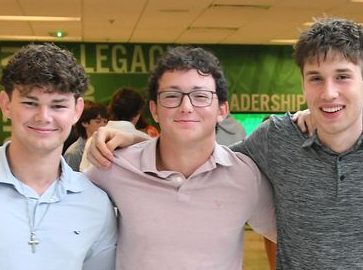
Most students walking through the halls at Gibbons wouldn’t look twice at “Benji.” Ben Paulakonis blends in easily, backpack slung over a shoulder, heading to class, laughing with friends. He doesn’t look like someone who has fought for his life.
But that’s by choice.
Benji was diagnosed at just 7 years old with a rare and aggressive form of leukemia: Philadelphia chromosome–positive Acute Lymphoblastic Leukemia (ALL). For years, his life revolved around hospital rooms instead of classrooms, treatments instead of practices.
“It was pretty bad for like four years,” he said. “I got diagnosed at 7, and I went into remission when I was 11.”
There were moments when survival felt uncertain.
“There were times my liver shut down,” Benji said. “I was in the ICU. I was in a coma for a few days.”
Philadelphia-positive ALL is one of the rarer and historically more difficult forms of childhood leukemia to treat. While overall survival rates for pediatric ALL today hover around 85-90 percent, cases involving the Philadelphia chromosome once carried far lower odds before targeted therapies became widely available. When Benji began treatment, remission wasn’t a guarantee. It was a hope.
Meredith Flynn, friend of Benji added, “He carries himself with a lot of strength, but he’s also really genuine and always good to talk to.”
Even after he reached remission at 11 years old, freedom didn’t come all at once.
“When you’re in remission, you still have to go for checkups to make sure it’s not coming back,” he said. “At first, it’s once a week. Then, after a year, it’s every few months. Then every six months.”
Each visit carried a quiet, familiar fear, the possibility of relapse.
By eighth grade, he had fully recovered physically. For the first time in years, his body felt like his own again.
That’s when something shifted.
Strength After Weakness
“When I was sick, I couldn’t play sports,” Benji said. “I got very weak.”
The weakness lingered long after the treatments ended. Energy came slowly. But instead of accepting that as his new normal, he decided to challenge it.
A major influence stood quietly behind that decision: his grandfather.
Now 78, his grandfather still goes to the gym three times a week. He volunteers with Habitat for Humanity. He keeps moving. He stays engaged. During Benji’s hospital stays, his grandparents were constant presences, visiting, sitting by his bedside, making sterile rooms feel less isolating.
“My grandparents were pretty prevalent,” Benji said. “If I was in the hospital, they’d come see me.”
Watching his grandfather remain active well into his late seventies reshaped Benji’s understanding of strength. Strength wasn’t just about athletics. It was about longevity. Resilience. Choosing to keep going.
“I think the reason I started getting active and going to the gym and trying to build a better physique is entirely because of him,” he said.
By the time he reached eighth grade, he was ready to try.
Coming into high school, though, he had no athletic background. No middle school sports teams. No years of training. Just curiosity, and a willingness to be uncomfortable.
Scrolling through Gibbons’ athletics page before freshman year, one sport caught his attention.
“I just saw wrestling, and I was like, why don’t I just try it?” he said. “It’s different. You never hear much about wrestling.”
It wasn’t football. It wasn’t track. It wasn’t one of the “common” choices. That was part of the appeal.
He wrestled for three years.
The sport demanded discipline, conditioning, and mental toughness, all things he had once been stripped of by illness. On the mat, there are no teammates to hide behind. No shortcuts. Just strength against strength.
Even after eventually stepping away from wrestling, he wasn’t finished challenging himself.
“I still wanted to do something,” he said. “And that’s when I found rugby.”
Rugby, like wrestling, isn’t the most chosen sport for athletes. It’s physical. It requires commitment. For Benji, that made it perfect.
Sports were never about popularity.
They were about reclaiming something that illness had taken.
Building Community, Building Self
His advice to other students, especially those hesitant to jump into something new, is simple: start anyway.
Sam Romanelli, a friend of Benji’s, said, “Benji is the type of guy who’s down for anything, always ready to try something new.”
He believes sports in high school, and even in college, are less about titles and more about structure and community.
“In college, you’re going to have more schoolwork,” he said. “But you’re also going to have a lot of free time. If you’re using your free time in a club, you’re building a community, and you’re just trying to make yourself better.”
To him, it’s no different than joining a fraternity or a campus organization. It’s about choosing how you grow.
“I love training,” he said. “I love pushing myself to get better.”
That love of growth extends beyond the field.
Recently, his grandmother recovered from cancer herself. The shared experience has deepened their bond, two generations connected by hospital rooms, resilience, and second chances. Where once she sat beside his bed during treatments, now he understands more fully the strength it took for her to do so.
It doesn’t always announce itself in dramatic moments. Sometimes it looks like early morning workouts. Sometimes it looks like signing up for a sport you’ve never tried. Sometimes it looks like a kid walking down the hallway, blending in.
Most students at Gibbons won’t see the ICU stays. The coma. The years of uncertainty. They’ll see a student like any other.
And that’s exactly how he wants it.