It is in the final months of winter, the dreary months of January and February, that the world seems at its darkest. That our lives, and by extension our faith, seem the most perfunctory. It is during this time, I feel the farthest from God. It is during this time that I feel as though His light is a glowing dot in the darkness as I stand under a shadow cast by “Ordinary Time.”
But as the world around us transforms in the spring, as the vacant branches of solemn trees begin to sprout the presence of green leaves and flower buds, our spirituality too can begin to blossom. As the shaded world begins to grow brighter under the beaming sun, our faith too begins to shine, and as the bitter cold winds of winter are replaced by a gentle breeze, it is easier to feel the breath of the Holy Spirit. Every year, during the blooming spring months of March and April, Catholics and Christians are invited to cultivate their faith through the 40-day period known as Lent.
The Lenten Season
Similar to how the season of spring is a time of natural renewal, the Lenten season is a time of spiritual renewal. Through the 40 days of Lent, we are asked to mirror Jesus’s 40 days in the desert. These 40 days allow us to prepare for His resurrection and in doing so, to grow our faith and deepen our relationship with God.
It is typical to focus on three areas of spirituality within the Lenten season; Prayer, Fasting, and Almsgiving.
Prayer: Chasing My Next God Moment
Our prayers are our direct communication with God.
When we are at mass, we as the congregation cry out the phrase, “Lord, hear our prayer!”
But our prayer doesn’t always have to be communal, in a chapel setting, and when seated upon a church pew. Prayer can be done whenever and wherever. It can be a silent whisper of gratitude or a shouted plea. Prayer can be a poem or a song, a sentence or a paragraph, scribbled on paper or just a thought. All prayers are beautiful.
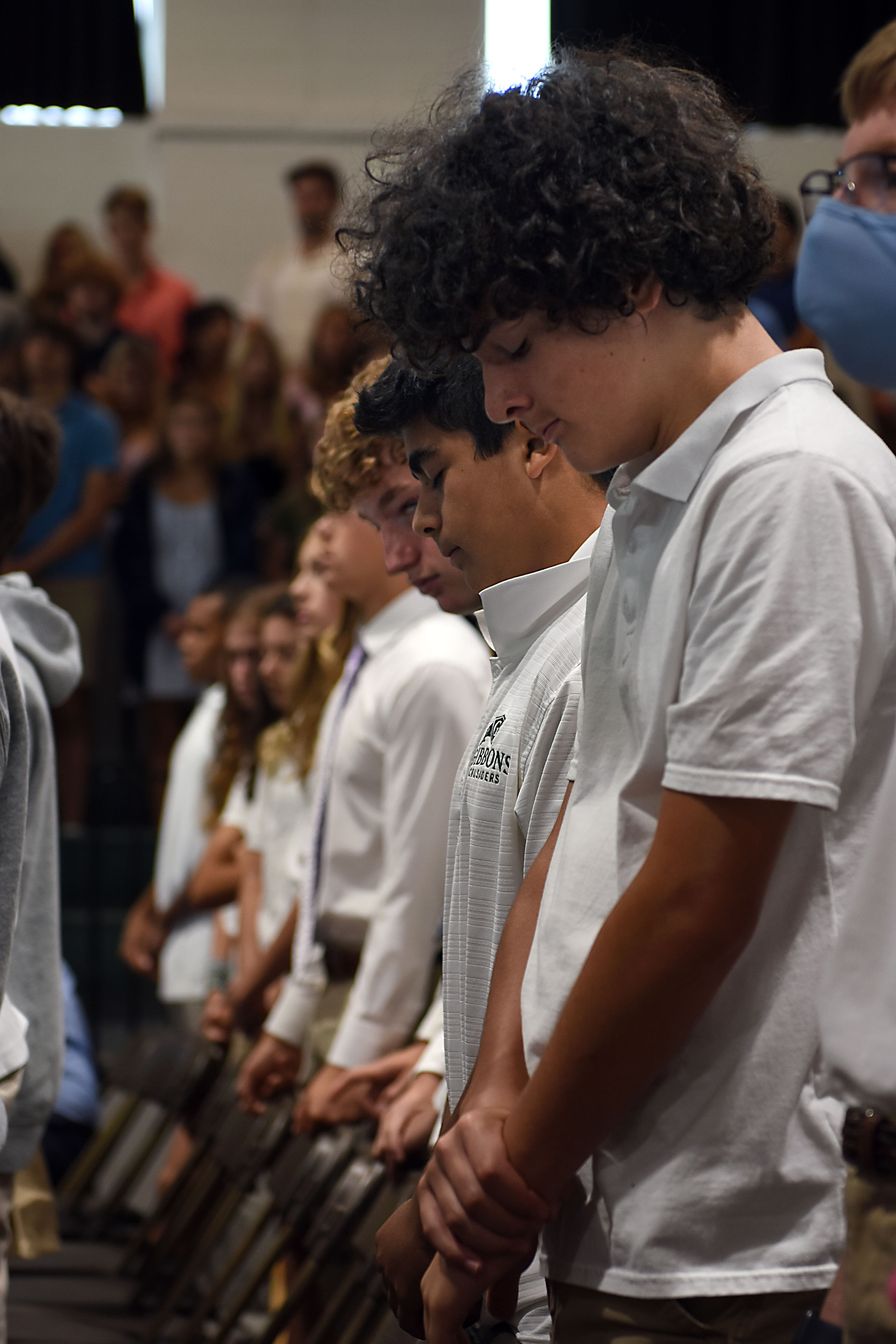
This Lent, I experimented with different types of prayer myself. While I was on Silent Retreat, I prayed more than I ever have in my life. Sometimes, I prayed with my eyes squeezed shut, my hands clasped tight, and my lips inaudibly forming words only God could hear. But also, I prayed through journaling. Through writing down my woes, my intentions, and my questions, I felt a sense of peace in being able to visibly see my prayer as I imagine God does. I prayed communally among my peers and too in secluded spaces throughout the Short Journey campus. And on the final day, I expressed my prayer through a poem.
Although prayer is a wonderful blessing, it is still something I struggle with. Sometimes when I pray, it feels equivalent to placing a conch shell up to my ear.
They say that the inside of a conch shell sounds like the beach. And in my experience, it does. But still, the sound isn’t exactly the same. From a conch shell, the sound is distant, like a murmuring ocean rather than a roaring one. And when I place a conch shell to my ear, that familiar but tainted sound makes me yearn for the beach, the bearer of the real ocean sound. And then, I can’t help but pose the question: when will I be at the ocean again?
And when I pray, and subsequently when I search for God’s response, He often feels as distant from me as the beach from my conch. Rather than a roaring response, a “God Moment” as I call them, the response to my prayers are often murmuring or undetectable. But just because the response or answer to my prayers isn’t immediate, doesn’t mean that it is not there. And then, in the times when I do have a “God Moment,” I immediately pray for another, just in the way that when I return from the beach, I immediately long to go back.
This Lenten season has taught me the value of prayer and the beauty of its unlimited forms. I have learned that it is important to be patient in prayer and to remain hopeful while I lie in weight. And just as I always am chasing the next beach day, now too I can always chase my next “God Moment.”
Fasting: “I am definitely a better version of myself after giving more to God.”
In the Catholic tradition, the Lenten season involves fasting during Ash Wednesday and Good Friday, and then abstaining from meat on all Fridays.
But fasting goes beyond not eating certain foods on certain days. It can also be something you choose to abstain from; a Lenten promise. The goal of this promise is that in the absence of your choosing, you will grow closer to God in some way.
It can be challenging to give something up for 40 days, but for many, the results have been fruitful and have prospered both personal and spiritual development.
For her Lenten promise, Alyssa Holloway decided to abstain from TikTok, Instagram, and buying food and drinks when she doesn’t need them. And although she found these sacrifices challenging, she has been able to observe growth in both her faith and her relationship with God.
“I have learned to appreciate what blessings I already have, I have learned to lean on my relationship with God in times that I am struggling, and I have become conditioned to give prayers of thanksgiving throughout my day,” Holloway said. “I am definitely a better version of myself after giving more to God.”
Kelsey Knoblauch decided to incorporate her faith into her everyday life through the unique Lenten promise of giving up listening to non-Christian music while driving.
“What started as a small, hard sacrifice turned into a deeper awareness of God’s presence in my everyday life. It helped me remember that my faith can grow in the smallest moments when I make room for it,” Knoblauch said. “It actually has been amazing and I honestly forgot that it was my Lenten promise.”
A Lenten promise is supposed to be challenging. It is through the struggle and turmoil of the task that the most growth will occur. If you are able to weather the storm and difficulty of abstinence, your faith will grow so much stronger as a result.
Almsgiving: “How can I pray for you today?”
The spiritual area of almsgiving refers to charity and love.
Charity, of course, refers to the typical donations of money and material goods, but it also references our actions, such as the act of extending a hand to another.
This helping hand can refer to anything, including spiritual aid. It can be the act of throwing a rope to someone whose ankles are grasped by the devil so that they have a secure cord of faith to pull them out of a sinful void.
And this is exactly what my friend Drew Flanagan has done this Lenten season.
“How can I pray for you today?”
This was the text I received from Flanagan one Friday a couple of weeks ago.
After Flanagan decided his Lenten promise would be to give up social media and mobile games, he began reaching out to his friends to ask them how he can pray for them in what he refers to as a way to “dedicate all the extra time away from my phone to God.”
Flanagan has utilized the absence of phone distractions to help others grow in their faith through dedicating just a couple minutes of his day to reach out to people in his life.
“We’re all one big community in faith, in Christ. And being able to extend that community or strengthen that community by texting and reaching out to other people has really affected my life because I feel I’m able to spread His word more by just talking to other people and being like well, He’s looking out for you and I’m looking out for you down here.”
The feedback to this action of Flanagan’s has been extremely appreciative. And as a recipient of his thoughtful gesture, I can attest that it was so meaningful to have someone care enough to donate their time and compassion to me through what I believe to be the will of Jesus.
When charity and good works are done with intention, their impact is all the more beautiful. And through his form of almsgiving, Flanagan hoped that he would be able to help others find God and faith in their own lives.
“I feel like everyone needs Jesus. And I feel like a lot of people in my life are kind of far from Jesus and aren’t really trying to get better.” Flanagan said.
But Flanagan is working to change this one person, one moment, and one message at a time.
“A man reaps what he sows”
When late-spring-early-summer arrives and the world is greener and laden with bustling flowers and fruits and sprouts, it is only because of the work already done rather than the “magic” of the season. A tree is in place only after the seed is first planted, the soil tended to, and the area protected. If these measures are not taken, then the plant would never have been able to be grown. If we in our faith do not take measures to cultivate our relationship with God, if we do not tend to it and protect it, then it will remain stagnant.
“A man reaps what he sows” – Galatians 6:7.
A gardener harvests what he plants.
And a worshipers’ faith only grows based upon how much they pray, how much they fast, how much they give, how much they meditate, and how much effort they put forth.
If by the end of spring, a farmer has done nothing to further the growth of their farm, they mustn’t be surprised if there is nothing to harvest and no flowers to admire.
Similarly, if we don’t utilize the Lenten season, then we mustn’t be surprised if by the end of the 40 days, nothing has changed.
If nothing is sowed, then in turn, nothing can be reaped.
“So then, just as you received Jesus as Lord, continue to live your lives in him, rooted and built up in him, strengthened in the faith as you were taught, and overflowing with thankfulness,” Colossians 2:6-7.
These words remind us that growth occurs when we are rooted in faith. And if we establish these roots in the Lenten season, we will prosper onward.
Why Limit Ourselves to 40 Days?
The Lenten season is a fruitful time in Christianity and Catholicism. For many, it is their peak of spirituality throughout the entirety of the year.
“I’ve seen it in a couple of my friends where they’ve gotten stronger in their faith this Lent because they’re either staying true to their Lenten promise or they’re really trying to grow in Him and grow in their faith,” Flanagan said.
And I have been a witness of this for many of my friends and peers as well. So many around me seem to be thriving, through F.I.R.E. Fridays, more Spiritual Life Involvement, or fulfilling their Lenten Sacrifice.
So why limit ourselves to 40 days?
We should continue to grow and flourish far after Lent has concluded because that is the ultimate purpose of the season.
“Even as Lent ends, I hope and expect that I will give more to God in less extreme but still considerable ways,” said Holloway.
And like her, I strive to make the blessings of Lent last beyond this season and into the next.
The seeds I have planted this Lent have only just begun to sprout, and it is my hope that I can continue to nourish them until they are fully rooted, cultivate them until I can bear their fruits, and then, begin planting more seeds so that my garden of faith is eternal.