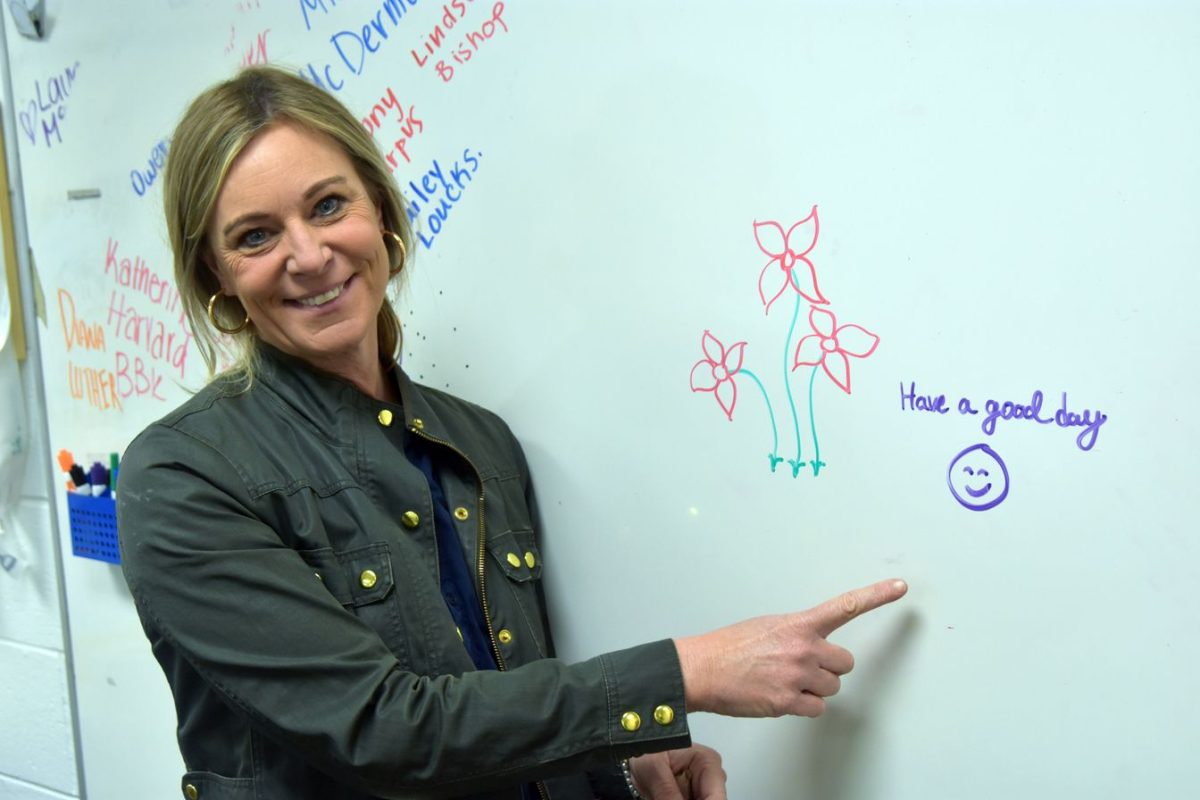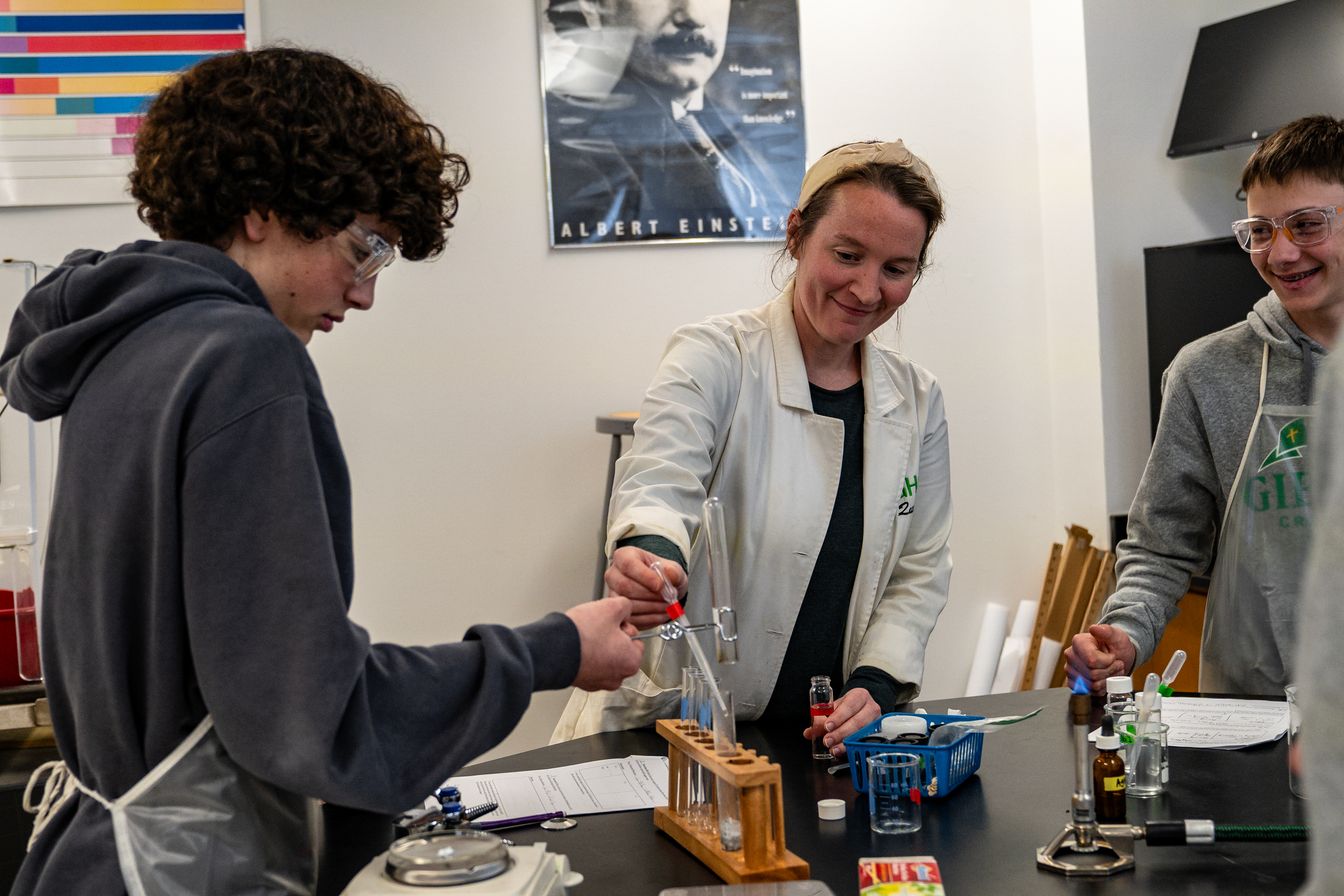
Chemistry is a complex subject that typically comes to life through experiments, lab work, and research by professional chemists. At Gibbons, chemistry comes to life through Mrs. Katie Kratzke. Anyone who walks past classroom 227 might get to witness anything from incredible AP-level experiments to in-depth lectures. But no matter what’s going on in Kratzke’s classroom, the sounds of laughter and awe are always heard.
Kratzke is a chemistry teacher and science department chair at Gibbons. She has been teaching here for 12 years and currently teaches honors and AP Chemistry. Her journey to teaching is one that shows how truly fascinated Kratzke is with chemistry, and how much she loves sharing this passion with others.
Falling In Love with Chemistry
Kratzke has been a teacher for 16 years, 12 of which are at Gibbons, which was a dream she had since high school. Teaching chemistry wasn’t her first idea; instead, it was teaching art.
“I really thought I was going to be an art teacher because I loved doing art and doodling and painting and anything crafty…And then when I took chemistry as a sophomore, I was like ‘Oh my gosh. This is awesome,’” said Kratzke.
After taking chemistry, Kratzke reconsidered her plans for her future career.
“I took it as a sophomore, honors chemistry. I fell in love with the topic,” said Kratzke.
In her junior year, when she took AP Chemistry, she decided that she wanted to be a chemist. Although when people in other levels of chemistry began to ask Kratzke for help, she realized how explaining chemistry was just as rewarding to her as learning it.
“My friends who were taking chemistry, like regular or honors, were struggling. And I said, ‘Oh I can help you with your homework’ and then I realized that not only do I love the subject, I love explaining it,” said Kratzke.
After high school, Kratzke went on to earn her bachelor’s degree in chemistry with a minor in education at Converse College in South Carolina.
Kratzke explained how chemistry still fascinates her, even after teaching the subject for a long time. She thinks that the constant discovery of new ideas and how they connect to concepts that have been known for hundreds of years is the most interesting part of chemistry.
“Every year there’s a new version of a phone or we develop new things, like ChatGPT or AI and all that stuff, and the science is forever evolving, but even as we discover new things in chemistry, the fact that they still fall into the same pattern that’s been around for 100 years is really cool,” Kratzke said.
The Complexity of Teaching Chemistry
Since chemistry is a complex subject, Gibbons offers three different levels: College Prep, Honors, and AP. CP and honors chemistry are offered to sophomores, juniors, and seniors, while AP is not offered until junior year. These different levels of chemistry are extremely different in the amount of rigor, material, and difficulty.
The difference in teaching these levels is very different due to the varying course loads. Kratzke says she likes the constant changing, and explained how she likes not always teaching the same thing.
“I like teaching different levels at the same time because I won’t really get bored with it,” she said.
Kratzke also reflected on the difference when teaching students with different strengths, and how each level of chemistry could work for them.
“My honors students, they’ve always been a math and science kid. And so, it’s fun to show them a new form of science they’ve never really seen much of before,” said Kratzke. “When I taught CP, that was fun…They might be more English or Social Studies students. So to have them in a science class where they get it, that was really fun.”
The giant step from honors to AP is a huge one, but it’s the class where Kratzke’s knowledge shines the most.
“AP is awesome too, because I get to do the college-level work with them and remind myself, ‘Oh yeah this is where chemistry gets cool and really explains things.’ I was a chem major. So there’s all this knowledge in my head that I don’t get to use as often with our intro classes that in AP I’m like, ‘Guys, just wait. This is really cool,’” said Kratzke.
Kratzke says that she likes the flow of AP Chemistry the most, explaining how the class can show connections between extremely different parts of chemistry.
“In honors chem, we get so segmented. It’s ‘This is unit 9, and this is what we’re doing’ and then we move on to the next unit. But in AP, it’s literally, ‘Hey remember that thing we learned last week? Here’s how it’s impacting what we’re doing now,’ and so the connectedness of it is really cool,” said Kratzke.
Due to the rigor of chemistry, it’s possible that students can feel overwhelmed and confused about all of the material. Kratzke understands the intricacy of the subject and says that asking questions will help her understand the part of the unit that students are struggling with, and therefore, be able to help her students more.
“Come in and ask. I think, especially as a science teacher, we really love it when students ask good questions and it shows what they’re thinking. We’re okay if you don’t know the answer yet, but if we don’t know that you don’t know, we can’t help you,” said Kratzke. “You can feel really dumb if you’re the only one going to office hours and you’re thinking, ‘but if everybody else gets it, why don’t I?’ But I’m gonna let you in on a secret, not everybody’s getting it. It’s just that nobody’s coming,”
Beyond the Classroom
Kratzke is very involved in activities on Gibbons’ campus, with anything from sports to academic-based clubs.
“I’ve done a number of things across campus, but currently it’s the trivia club and then Women in Stem and hopefully the beach volleyball club will run in the spring or summer,” said Kratzke.
During her first years teaching at Gibbons, Kratzke was one of the indoor volleyball coaches for JV and an assistant coach for varsity. After leaving the volleyball program, she helped start the beach volleyball club, which she is hoping will start up again sometime this spring.
Kratzke is also the moderator of different clubs at Gibbons. She moderates the Women In STEM club and an academic trivia club alongside Mr. Chris Poisella.
“I also help moderate, along with Mr. Poisella, we run a trivia club or academic team club where our students compete. There’s a TV show called Brain Game. Students from different high schools compete against each other at trivia. So we run that together,” said Kratzke.
Whether it’s sports teams or academic clubs, Kratzke stays involved in many activities in the Gibbons community.
What Teaching Means to Ms. Kratzke
Being a teacher is a hard job, full of responsibilities, repetitive tasks, and frustration. To Kratzke, it’s all worth it. When asked what her favorite part about being a chemistry teacher was, Kratzke reflected on the connections she could make with her students.
“Being able to share that information with people, but to do so with students and show them how I care for them, or how to understand, or how to be there for them as another adult in their life as well. That’s one of the benefits, not only the teaching. Teaching here, it’s been really great because it’s totally normal to say, ‘Hey, I’m thinking of you,’ and it’s just another way to reinforce that you’re being supported. And I get to do that while also talking about chemistry, which is really great.”
Teaching can seem like a repetitive job that stays the same year after year, but Kratzke says the meaning of teaching has changed for her over the years.
“I think for me, teaching has kind of evolved from not just sharing the content, but also thinking, ‘What’s best for the kids and how I can support them.’”
The connections that Kratzke has with her students are ones that she truly values. She hopes to not just be there for them in high school, but throughout college and whenever they need her.
“Teaching students multiple years in a row, or even some of my seniors who are lab techs, I’ve had them for three years. And that’s really cool, to get to know them and then later on to be invited to graduations or when they get married, or even just keeping in touch with them in college, and just to know that the impact is continuing,” said Kratzke. “That’s really what makes it, a lot of it, worth it.”