It is widely known how big Gibbons’ fine arts department is, and how in-demand AP classes are, so to have an AP fine art class with only seven students seems strange. This is the case with AP Music Theory, the only music-related AP offered at our school, and the only music-related AP offered by College Board.
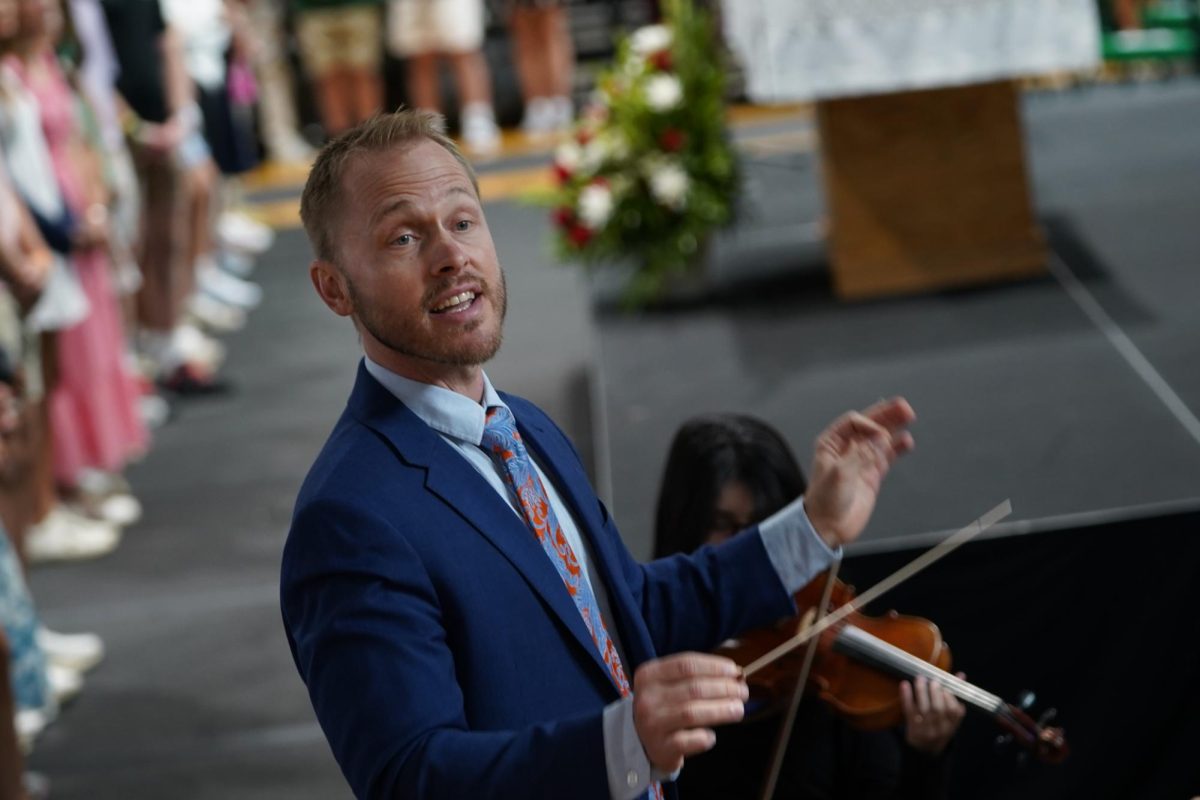
Taught by Mr. Mark Cashin, the class has been available since around 2000, and has been taught by Cashin for 10 years. The class is described by College Board as “a class that will deepen students’ ability to recognize and describe musical processes. Students learn how to read music scores, write music, and expand their singing skills.”
“I take them all the way from ‘This is a staff’ and ‘These are pitches’ (to) ‘These are how we arrange those pitches’ all the way to how to write your own compositions and prepare for the AP Exam,” said Cashin.
Prerequisites
Considering that this is an AP class, some would think that having a collection of musical prerequisites is necessary, but that’s not the case. While Cashin recommends some music experience so students have prior knowledge, it’s not required.
“Some people come in with some writing ability and others come in and haven’t even put a note on a piece of paper themselves, but it’s just being able to create and having that opportunity to create,” Cashin said.
Some students who join this course have prior private piano experience, like taking lessons outside of school. Cashin recommends that those students take this course to apply that prior knowledge to a school course.
“I would definitely recommend having a few years of music experience, like band or choir. I think they would find success in this class and…if you want to care and perform diligent work, then you could definitely be able to get at least an A in the class,” said Erin Callaway, an AP Music Theory student.
“So the thing I want people to know is that if you take or have taken private piano, this is an awesome class to take because it directly applies. And then this is something that can really allow you to take all that individual study you’ve done outside of school and apply to a course in school.”
A Day in the Classroom
This course isn’t like traditional music classes, where the whole class sits and plays their instruments. Instead, it is a lecture course with discussions, where students can work together to decode and learn about musical pieces.
“It’s not just lecture based, but it’s also like, we’ll pull out a table and sit around it and talk about music. That to me is really cool,” said Cashin.
Since this class covers four semesters of college-level music theory, most would think that the class is fully focused on the AP material in preparation for the exam. Cashin teaches the class differently, he wants students to know the basics well, so they have a strong foundation for learning the AP material. Cashin described how he doesn’t talk about the AP exam until the second semester, to make sure students completely understand the material.
The AP exam consists of a multiple choice section, a written free response section, and a sight-singing section. The thought of singing on an exam could sound terrifying to some, but the amount of practice that the students get in class will help them become more confident and comfortable in their voice.
“We write music, we sing every day. So we do have that vocal component to the class, which everyone’s always super nervous about until they realize that it’s not that scary. Everyone’s a pretty good singer if they kind of let down their guard and just enjoy the time to learn the craft,” said Cashin.
The class is an AP level course, so Cashin says that students should expect 30-45 minutes of homework a night. He explains that the homework is always reinforcing the material learned in class. Tests are also the same, used to reinforce the material for students.
“I’m also one of those teachers that, like, I don’t trick people when it comes to taking the test. I tell you what’s gonna be on it and you produce the results,” said Cashin.
The Impact Music Leaves on Students
While this class is very different from most, it’s an impactful experience that will stand out from any core classes. If a student is interested, Cashin says to come talk to him or old students. He also advises students to not shy away from a different style course.
“It’s just really fun, honestly. It’s supposed to be an elective, it’s supposed to be a fun class at the end of the day. So really, just have fun and learn a lot as well,” said Callaway.
Cashin’s main goal for the course is not for students to pass the AP Exam, but for students to genuinely enjoy and be able to use the material they have learned when they leave Gibbons.
“I’ve had kids that take this course, and they go on to major in music, music business or marketing, or something along the lines of a non-traditional performing aspect of music. And I have some kids that go start their own rock band, and they take this knowledge and they’re like ‘Now I can compose songs, now I know how to write.’”
The one thing that Cashin hopes students will take away from this course is that composing and understanding music isn’t a hard task. He hopes that students will hold on to the material and the memories from the class.
“I’ll have a kid come back and be like, ‘Was our class your favorite class?’ I’m like, I don’t have favorites, but you thinking that your class was special means you had a great memory of it. So that’s what we want to do. We want to create courses for students that provide great experiences for them to bring them educational joy, while they’re here and afterwards. Because then they’re going to look for those kinds of teachers and those kinds of memories in their educational pursuits.”
There are many reasons for joining this class, from expanding your musical horizons to deepening your knowledge of composition, but Cashin points out that music will always be a part of our lives.
“You will be a consumer of music for your whole entire life. So this allows you to have a greater understanding of that.”